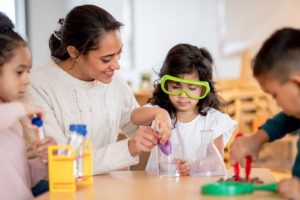
Children who get regular chances to explore and investigate in science build stronger reasoning skills over time. In one large review, hands on science and enquiry based learning showed meaningful improvements in pupils’ thinking and understanding when compared with more passive approaches (Education Endowment Foundation, 2018). That matters right now because in 2026 children are growing up with AI tools and fast answers everywhere, which makes howthey think just as important as whatthey know.
This guide explains how science activities for KS1 Blackburn can develop critical thinking in young children in ways that feel playful, practical and confidence building. You will learn what critical thinking looks like in Year 1 and Year 2, which local style activities work best, how to run safe experiments at home or in groups, and how to link everything to National Curriculum science without making it feel like school at the kitchen table.
What critical thinking looks like in KS1 science?
In KS1, critical thinking is not about long written explanations. It is about children learning to notice, question, test, and explain in simple ways. Science for young children is a brilliant fit because it gives them a reason to slow down and look closely at what is happening.
How this matches National Curriculum science
In England, KS1 science places strong emphasis on working scientifically through asking simple questions, performing simple tests, and gathering and recording data to help answer questions. The National Curriculum also expects children to use simple scientific language and to talk about what they notice.
When you choose practical science activities, you are not adding extra work. You are giving children a child friendly route into scientific enquiry that naturally strengthens thinking skills that support reading, maths, and real life problem solving.
Why practical science activities develop critical thinking faster than worksheets?
Worksheets can help children rehearse vocabulary, but critical thinking grows best when children have to make decisions in the moment. Practical science activities create natural pauses where a child must choose what to do, what to look for, and how to explain what they saw.
What research says about enquiry and learning?
The strongest gains come when children are actively involved and the adult guides the thinking rather than giving all the answers. A major review of STEM education found enquiry based approaches can improve attitudes and achievement, especially when teachers or leaders provide structure and good questioning (National Academies of Sciences, Engineering, and Medicine, 2018).
There is also clear evidence that metacognition and self regulation improves learning outcomes across subjects, and it can be taught through routines like planning, checking, and evaluating which fit naturally into KS1 science experiments (Education Endowment Foundation, 2021).
Why this matters in 2026?
In 2026, children are surrounded by instant explanations from videos and AI search. That can be helpful, but it can also reduce opportunities to practise thinking. Practical science activities slow things down in a joyful way. Children learn to trust their senses, test ideas, and change their minds when the evidence changes. Those habits are the heart of critical thinking.
Science activities for KS1 Blackburn that build critical thinking step by step
Blackburn is full of everyday science opportunities because families have a mix of parks, canals, weather changes, busy roads, older housing stock, and varied community spaces. You do not need fancy equipment. You need simple materials and a clear thinking routine.
A simple routine that teaches scientific enquiry
This routine is also a gentle way to develop language. A strong early language foundation matters because it supports reasoning and reading comprehension. Vocabulary gaps can appear early and widen without support, which is why talk rich activities are so valuable (Royal College of Speech and Language Therapists, 2023).
Comparison table: which KS1 science experiments build which thinking skills
If you are choosing between ideas for a home session or a group workshop, use this quick comparison. The aim is not to do everything. It is to choose activities that stretch different parts of critical thinking across the month.
KS1 science experiment idea | Best critical thinking focus | Easy way to record results | Common adult pitfall |
|---|---|---|---|
Ramp and toy car friction test | Fair testing and comparing | Tally chart of which surface goes furthest | Changing ramp height and surface together |
Which material is waterproof for teddy | Planning a test and using evidence | Simple grid with smiley faces for dry or wet | Not agreeing what counts as wet |
Seed growth in light and shade | Patience, patterns over time | Picture diary and weekly height marks | Moving pots around so conditions change |
Shadow investigation with torch | Cause and effect reasoning | Draw shadow shapes at different distances | Giving the explanation too quickly |
Melting race with ice | Prediction and controlling variables | Order list from fastest to slowest melt | Using different size ice cubes |
What is changing in 2026 and how to keep science activities future ready
In September 2026, families are navigating a fast changing education landscape. AI powered homework help is common. Many parents are also balancing budgets and looking for low cost enrichment that still feels high quality. At the same time, schools and home educators are putting renewed emphasis on oracy, vocabulary, and real world problem solving because these skills support learning across the curriculum.
Trend: more focus on talk and reasoning
Oracy and structured classroom talk have gained traction across the UK, helped by growing awareness that speaking and listening support learning and confidence. For KS1, science is one of the best places to practise respectful disagreement such as “I do not think it is the same because…” in a gentle way.
Trend: digital tools used more carefully
Children can watch a science clip in seconds, but the thinking comes from doing. In 2026, best practice is to use digital as a spark and keep the main session hands on. If you use an AI assistant, use it for question ideas, safety reminders, or vocabulary lists. Avoid using it to supply explanations before children have explored.
Trend: inclusion and sensory friendly planning
More providers are designing activities that work for children with different communication needs and sensory profiles. This includes predictable routines, visual supports, and options for quieter participation. It is good practice for any group, not just children with identified needs.
How to measure progress without turning science into a test
KS1 children do not need formal assessments to show progress in critical thinking. You can spot growth in the quality of their questions, their ability to predict with a reason, and their willingness to change their minds after seeing results.
A gentle way to record learning
Try a “science postcard” at the end of each session. Children draw what they did and finish one sentence stem such as “I noticed…” or “Next time I will…”. Over a term, you will see thinking become more structured and confident.
This matters beyond science. International evidence continues to link broader skills like reasoning and problem solving to later outcomes. For example, the OECD has reported that stronger problem solving skills are associated with better education and employment pathways, and that these skills can be developed through teaching approaches that require reflection and decision making (OECD, 2019).
Conclusion
Science is a joyful way for KS1 children to build critical thinking because Simple Lessons CIC turns curiosity into a simple process of wondering, testing, and explaining. In 2026, that matters more than ever, as children need to handle information wisely and learn how to check ideas rather than simply accept the first answer they hear. Through engaging, age-appropriate science learning, Simple Lessons CIC helps children develop the confidence to ask questions, explore evidence, and think for themselves.